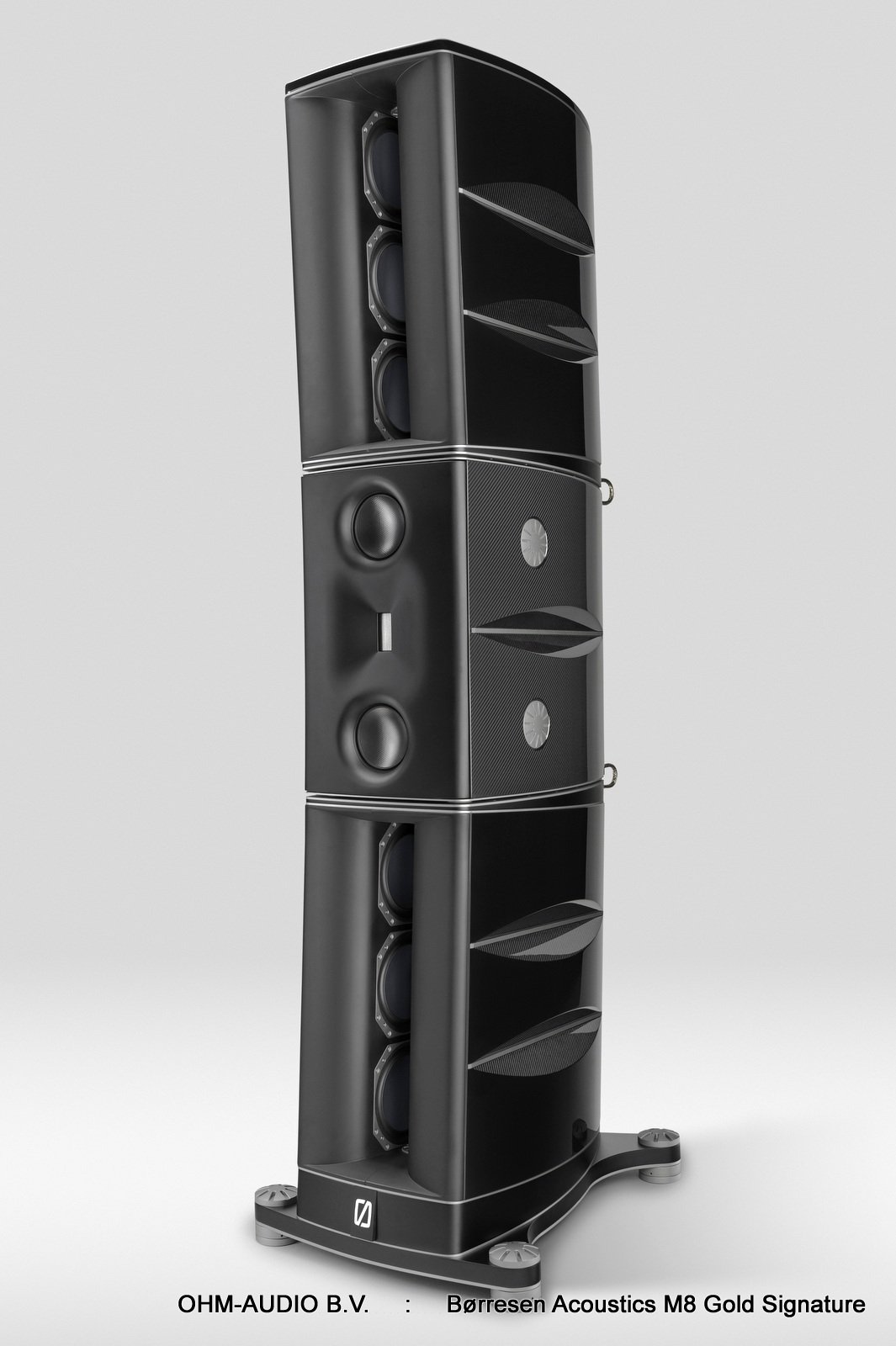
The voice of your Hifi or High End Audio installation
In our view, speakers are the most determining link in every Hifi or High End installation. Place 10 different speakers next to each other, and they all sound completely different. The task of a speaker seems simple. The speaker converts electrical current from the amplifier into acoustic vibrations. Simple, right? Not quite. The speaker is an electroacoustic converter, and that is the most difficult job there is in our Hifi world. Converting electrical alternating voltage into acoustic sound waves can be done in many ways, as it turns out. There is no single best way.
In our webshop we distinguish different types of speakers. We have:
Floor-standing speakers.
By this we mean medium to very large speakers whose cabinet stands directly on the floor. These speakers are usually full range and can reproduce the entire musical spectrum.
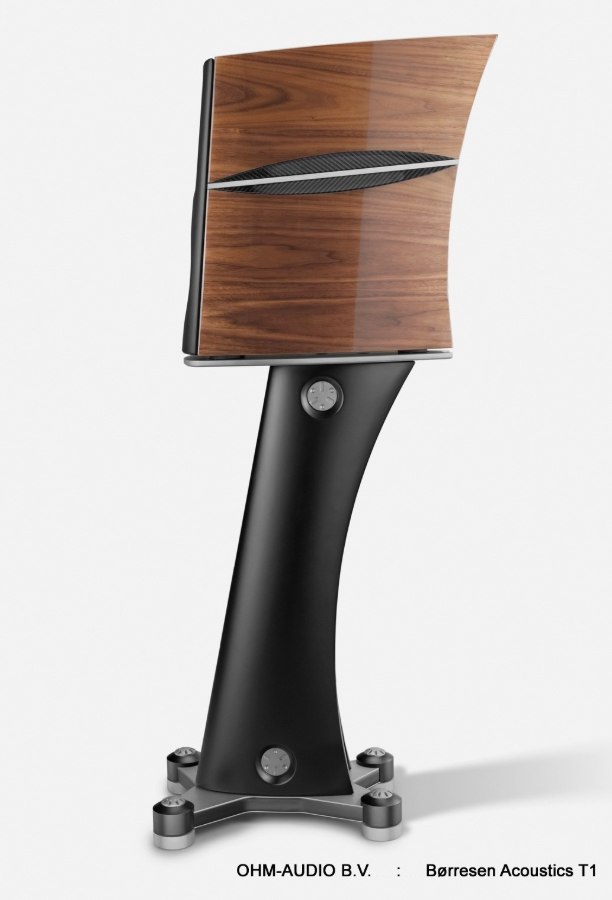
Compact speakers
Previously known as bookshelf speakers. These are speakers with a compact cabinet. Usually they are set up with a matching set of speaker stands for sound quality. A good example is the Borresen T1 shown nearby. They are no longer placed in bookshelves, if only because many people no longer have a bookcase at all, but acoustically it also doesn't do much good to place such a fine speaker in a cabinet.
Active speakers
Active speakers are an exception in the Hifi and High End Audio world. With a set of active speakers you eliminate many cables and amplifiers in one go. A source and a cable; to the speakers, power cable connected, and you're done. Active speakers certainly have certain advantages (just listen to a set of Kii Seven, Three or BXT) but there are some things you can't do with them. We can tell you all about it.
Subwoofers
Subwoofers are usually also active speakers, and they are often added to existing Hifi & High End Audio installations to improve bass reproduction.
Apart from the main speaker category, we also distinguish different types of speakers. Technically speaking, there are many differences in speakers.
We distinguish:
Dynamic speakers
1-way speakers
2-way speakers
3, 4, 5 or more-way speakers
Horn speakers
Electrostatic speakers
Magnetostatic speakers
Ionic speakers
Ribbon speakers
In all speakers the principle is the same, namely converting electrical current into acoustic vibrations (sound), in whatever way. The conversion of current to sound itself is done by the drivers, and they come in all shapes and sizes. The drivers are housed in some kind of enclosure. These enclosures also come in many shapes and sizes. Different cabinet materials such as wood, aluminum, stone, glass, plexiglass, MDF, paper, and so on. They are active or passive, sealed or have a bass reflex system or a transmission line, they are line arrays or not, they are long, wide, high, deep, or not. You can't think of anything that doesn't exist. Then you have the many different ways to use the drivers. There are actually countless different ways to convert electrical current into sound, and that is also the main reason why the greatest sonic differences exist in speakers.
We are often asked: What is the best speaker, or what do you think is the best speaker? Our answer is always the same: The best speaker does not exist. And by now we know quite a lot of speakers, good speakers, mediocre speakers, and many more speakers in between. It just depends on what someone wants to do with them. What music does this person play? How loud? In what kind of room are the speakers placed? What is this person's music taste? What is the budget for the speakers? What kind of amplifier is available? You name it. We at Ohm-Audio BV can help you make the best choice within your budget. But the choice of the speakers themselves is yours! With us, Ohm-Audio BV, over a good cup of coffee!
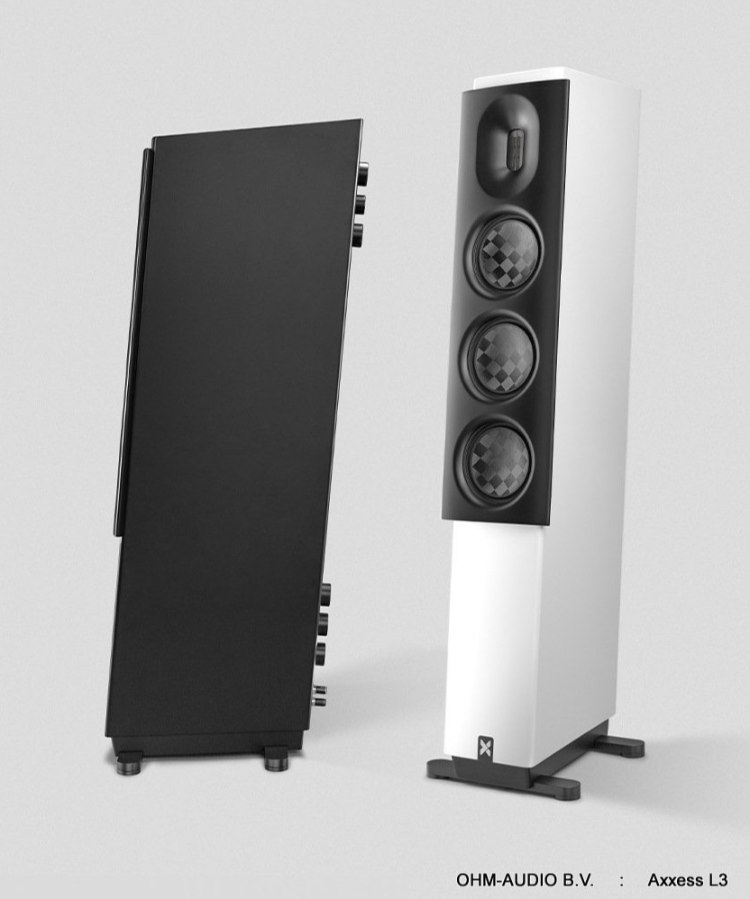
Ohm Audio BV evaluates the speakers that come to us in a number of areas. We do this internally, for ourselves, to determine where and in what situation we can best place the speakers. This yields a certain score. Now, it doesn't mean that the speaker with the most points is the best speaker for you. Perhaps some points are more important for you and others less so. Each component is examined, pardon, listened to for its different characteristics. This way we can help you choose the perfect speaker for you.
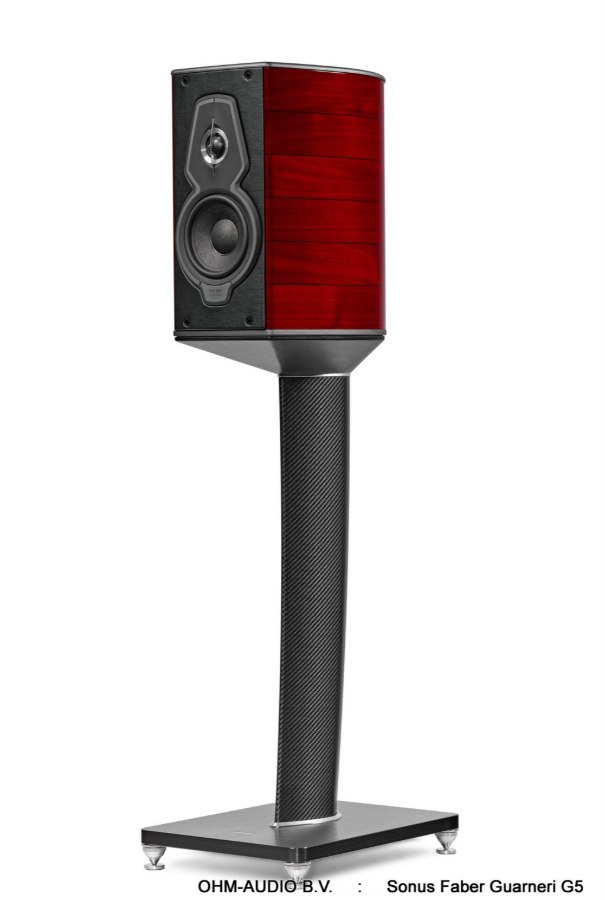
We usually judge a speaker first by its appearance. Does it look good? Do they feel solid? A famous way for audiophiles to assess cabinet quality is the knuckle test. You gently tap on the cabinet and listen. Does it sound nicely rigid? Not hollow? Is the resonance high? Or low? Low is usually better, but not always. The current generation of speakers is often very well made, and you've never bought so much sound quality for such a low price. But speaking of sound. To characterize the sound properties of a speaker is not easy. We pay attention to, among other things, the following points.
Frequency Response:
We assess the speaker on its qualities in frequency response.
Subbass: Below 30Hz. How is the sub bass? Heavy? Light? Fat? Lean? Not only the amount of sub bass determines the score, but certainly also its quality. But for someone who loves deep and heavy bass, this is an important point.
Bass: 30Hz - 80Hz. How is the bass? Tight? Does doubling occur? Is there a resonance peak in the bass? Is it well damped? How is the distortion? This is important for everyone, because distorting and booming bass is good for no one.
Lower Midrange: 80Hz - 300Hz. Very important area with regard to the "drive" a speaker has. How is the strength and quality of this area? Is it muddy? Or clean? Does the speaker have power?
Midrange: 300Hz - 3000Hz. The most important area of the speaker. Partly because our ear is most sensitive in this range. The human voice is also in this range, and many are very sensitive to the absolute qualities of a speaker in this area. It's not so much about the strength but purely about the quality of this area.
Upper Midrange: 3000Hz - 10000Hz. The important area adjoining the midrange. Important for transparency in the sound. Cymbals, high instruments, benefit from a qualitatively good upper midrange reproduction. In this area it is determined whether a speaker sounds fresh or warm. Sharp or dull. Restrained or aggressive.
Treble: Above 10,000 Hz. Determines the detail and spatiality in a speaker's sound. How is the radiation? Does it sound airy?
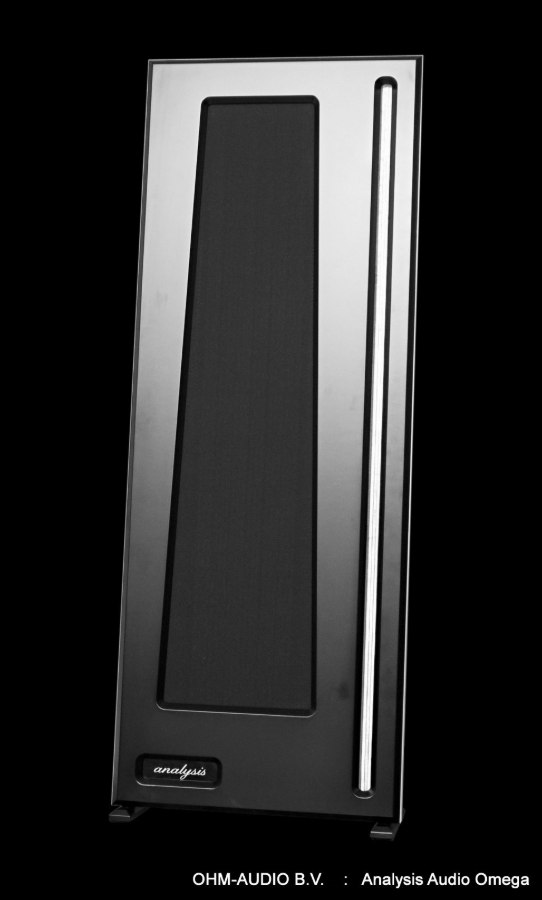
In addition to technical properties, personal, thus subjective, properties also play a major role. The following things come to mind:
We assess each speaker on its audiophile qualities. This is separate from the qualities of a speaker in the frequency response. Granted, these are the more "vague" concepts, but every audiophile knows exactly what is meant.
Soundstage: This is about the size of the soundstage, or the image. The larger the image, the better a Concertgebouw orchestra is represented realistically. The smaller the picture, the more the speaker is suitable for reproducing "small" music. Some speakers always sound very large, and that suits listeners who listen a lot to live and classical music, for example, but less so for people who listen to small ensembles. The best thing is to choose a speaker that is honest, so sounds grand when it should, and also small when necessary.
Imaging: Imaging is related to the soundstage. It means how precisely and naturally the soundstage is reproduced. Can singers and musicians be localized? Or is it a vague blur? Does the sound from a musician come from one spot, or does it come from everywhere? The more accurate, the better, and thus more points. However, if you like a large, and perhaps somewhat vague bell of beautiful music, don't worry about it here. Just forget imaging.
Listenability: We find this a very important property of a speaker. Can you listen to it easily? Or does the sound tire you out? Do you have to make an effort to listen relaxed, or are you right at "home"? Do you want to listen all night? Or do you think after an hour or two, turn that set off? The better the listenability, the better the speaker in our view.
Spectacle and Fun: Also very important for most music lovers. Is there something to experience? Or does it sound boring? Does the sound crackle off? Or does everything come across very sedately? Are you on the edge of your seat? Or do you regularly fall asleep in the listening chair? We at Ohm-Audio BV believe: Go for spectacle and fun too. The more fun, the better. Of course, this is purely subjective.
Points can be earned here with the underlying technology and build quality of the speakers.
Drivability: What does the speaker do with a simple amplifier? Does it already play well? Or do you absolutely need to put a heavyweight on it? Does the speaker work well with tube amplifiers? The easier to drive, the better, because more different amplifiers can be used. But for absolute quality, this doesn't matter. However, we have concluded that the easier the drivability, the better and easier the music flows out.
Build Quality: This does not mean how heavy a speaker is, but how well it is built. If you fill a poor speaker with concrete it is also heavy, but that doesn't make it a good speaker. How is the finish? Plastic veneer or real wood? Sprayed rough once or sprayed smooth, sanded and polished several times.
Extra: Here a speaker can earn extra points with specific construction technical qualities, or very special units that really add something special.
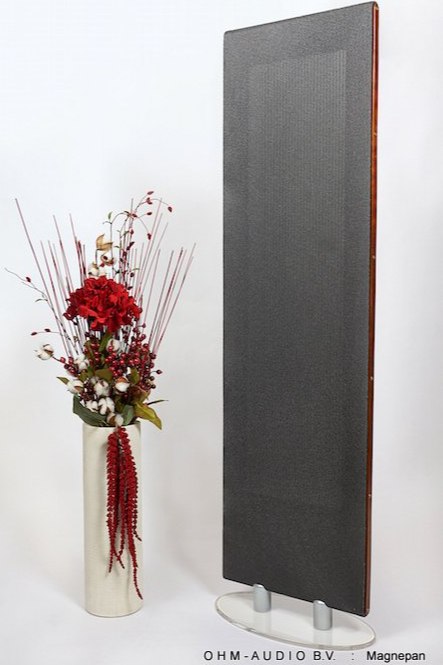
Appearance may also play a significant role in your decision-making. The speakers will be visible somewhere in your home, and usually in the living room. It would be a shame to hide a good speaker behind the couch; you simply won't hear its qualities anymore. A good speaker should be visible, aimed at the listening position, and not tucked away in a corner. It makes sense, then, that appearance also plays a major role when choosing your speakers. Of course, the best scenario is when the speakers of your dreams look fantastic and sound fantastic too!
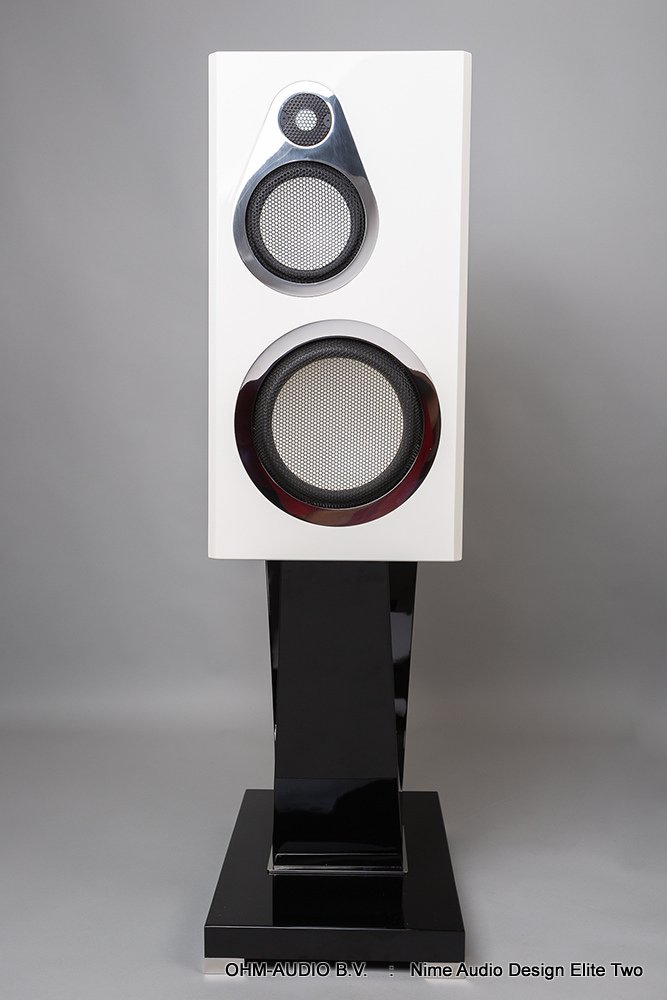
Buying speakers for your home is not always straightforward. Certain technical qualities are objective, but important sonic qualities are often purely subjective. And what we find sounds beautiful, you may not, and vice versa.
That's why we invite you to visit us and assess the speakers carefully on all aspects. Ohm-Audio BV has 2 excellent listening rooms for you to evaluate what you think of the sound. Please make an appointment in advance so we can prepare everything for you.