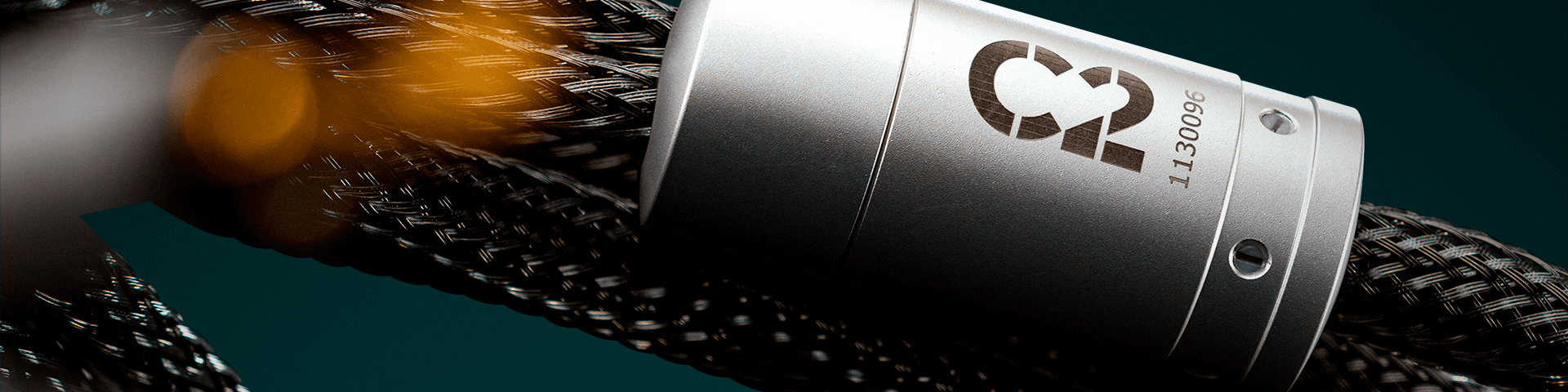
A good Hifi or Highend audio system stands or falls with the right cables. If you connect an audio system of €100,000 or more to the most simple and cheap cables and the sound is messy, shrill and not coherent. A good audio installation should be seen as an ecosystem, everything plays a role and works together. A complete set matched to each other whereby the foundation and everything around it is set up and put together based on quality and matching will always sound fantastic, whether it's a set of €5,000 or a set of €50,000, the difference ultimately comes down mainly to the amount of detail and the ease with which these are displayed, this also ensures that the music touches you more and therefore there is improved emotional transfer. Ultimately it's about the music, that's where the emotion is, but the quality of a set, and especially good cabling as a connection between all equipment and also the speakers provides more musical enjoyment. Also special, the better the cabling and matching, the louder you can play without problems, and the longer you can listen without listening fatigue.
There are a lot of brands on the market and most have their specific properties, which you see reflected in their entire range. Differences lie in the choice of materials, conductors of copper, silver, gold or a combination thereof. A shield of Teflon, PVC, copper mesh or a combination of different materials. But also the construction of the cable, single thick stiff solid core conductors with stiff shielding, or Litze / Stranded conductors which are much more flexible, amorphous conductors without crystal bridging. And also the way the conductors are wound.
All these factors influence the behavior and sound of the cable. One cable sounds extremely fresh, open and direct, for some people beautiful and for others too sharp or too present. The other cable sounds warm and full and refined, for one person wonderfully musical, for another person too slow and too tame. Or somewhere in between. One cable throws the sound more forward, where the other cable looks for it in the depth of the soundstage. Personally, we believe that a cable should not restrain or color, but also should not force. A cable should remain neutral and complement your system, and not make the sound revolve around their character.
Combining
Now you can use those properties to compensate for a less good property of a single component, or even more dangerously, the rest of the system. Correct one error with another error. Combine a somewhat sharp-sounding speaker with a speaker cable from brand 6, and the speakers fortunately sound a bit fuller. Only now it turns out that some life has also disappeared, the speed has gone out. What you're actually doing is straightening out the somewhat wrong character of the speaker with the specific character of cable 6, but you're also introducing other problems in the process. That's how it works with the entire system. You can not only adjust the properties of the speakers, but also the characteristics of the sources, the preamplifier, the power amplifier, the interlinks, the power cords and so on. Ultimately, you keep going, and often solve one problem, but introduce another. But to be honest, that can't be the intention, because then you keep at it. On the one hand, that's fun, because yes, our hobby, but still, you want music in the room, apart from the speakers, you want to see a 3D image, virtually, which sounds very interesting, in other words, you want: Goosebumps!
Ohm-Audio BV sells various brands of audio cables, but we are most delighted with Ansuz Acoustics from Denmark.
Ansuz Acoustics is part of the Audio Group Denmark (AGD) and they make 4 brands of High End Audio:
Ansuz Acoustics makes quite a lot. From power cords to speaker cables, from interlinks to Ethernet cables, power switches, power boxes, Titanium racks, you name it.
What the cables have in common is the following. Ansuz Acoustics strives for absolute neutrality, and through passive and active noise suppression, they deliver the cleanest reproduction we know of, and the higher you go in the line, the more refinement and less noise. So you hear more music, on an ink-black background. Their DTC and Supreme cables provide the most emotional reproduction we know of.
The great advantage of the Ansuz Acoustics cables is therefore the property that they least affect the music signal, and the noise, which cables do pick up (Wifi/Dect/Bluetooth/Cellphone etc), they suppress the most.
That has great advantages, and you can let your Hifi and High End audio system sound optimally with them.
Problem
It can happen that someone has a system that has sharp-sounding speakers. Actually, the system is not in order. But then one tries to remove this sharp sound with certain characteristics of other cable manufacturers. That sometimes works, partly, with e.g. cable from brand 2. Only you don't just take away the sharpness, but emotion also disappears. It's as if you want to combine too many horsepower in your car with a brake that is continuously dragging slightly, to reduce the horsepower. It seems like the illogical way to us, you put the cart before the horse.
Our solution: Replace the speakers, and wire with the right cables.
This is of course not the only solution. Speaker placement is one thing, as is room acoustics, but if it's a component (Speakers/Amplifier/Source/Power conditioner) with an annoying property (Sharp or harsh sounding, thin, boomy etc) then there's nothing to do but replace such a component. With Ansuz Acoustics cables, it will in any case not be the cables' fault. But always try is our advice.
Ohm-Audio BV has most cables on DEMO so you can try them.
As a true audiophile, you of course already have a good meter box switch installed in your meter box, preferably a fuse-less Gigawatt switch. And of course the output of the switch is connected with a good quality shielded power cable, preferably made of solid core copper. The best cable we have is the Gigawatt LCY Evo cable. This sounds fantastic, but is quite stiff. For this reason, the Gigawatt Powersync cable has been brought to market. Almost as good, but flexible. This cable ends in a good outlet. To the outlet you connect a high-quality power distributor, with or without filtering. We recommend the power distributors from Ansuz Acoustics and Gigawatt. Then initially it's about the power cords, from the power distributor to the components.
Between the components are interlinks.
What is an interlink?
An interlink is literally a link between 2 devices. This can be a digital interlink or an analog interlink.
The most commonly used digital interlinks for audio use are:
USB SPDIF over Coax
SPDIF over Toslink
AES/EBU
I2S
Clocklink
The most commonly used analog interlinks for audio use are:
Cinch
XLR
Cast (Krell only)
As the last important component, there are the speaker cables. The speaker cables can be seen as an interface between 2 components: The amplifier and the speaker. The amplifier sends current to the speaker, and the speaker reacts by converting a large part of the signal into acoustic output (Sound) but the speaker reverberates, and also sends the signal back to the amplifier. This process must be balanced as much as possible, which is why the speaker cables must be as good as possible.
Ohm-Audio BV 2025-10