The heart of a serious Hifi & High End Audio installation
The preamplifier can be considered the center of the ultimate Hifi or High End audio installation. But is a preamplifier really necessary? An integrated amplifier has a built-in preamplifier, and many streamers nowadays have an adjustable output that can control volume digitally or with an IC in small steps. So what would you still need a preamplifier for?
Yet the role of the preamplifier is underestimated in a truly high-quality Hifi or High End Audio installation.
Why use a preamplifier if you can also control volume digitally? What can an extra device in the signal path possibly improve? Surely it can't sound any better?
You might say that...but still.
On the one hand, it seems so logical. Suppose you have a beautiful Bricasti M1SE DA Converter that can control volume with an ultimate digital processor, or you have a CD player with adjustable output, and the built-in buffer can deliver up to 2Volt, 4Volt or 6Volt. So why would you need an external preamplifier?
In any case, you then have an extra device in your setup, so extra electronics in the signal path, an extra signal cable, an extra power cord....surely that can't make things better? Besides, there are sometimes considerable costs involved. It sounds logical, and yet...and yet.....
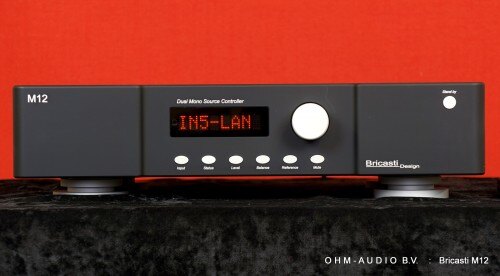
From experience we know that a good Hifi or High End Audio installation simply sounds better with a good preamplifier in the set. The latter makes sense. A poor, mediocre or at best adequate preamplifier certainly won't bring improvement. At most a change, and that's not always positive.
So how does your High End Audio installation end up sounding better with an extra device in the signal path?
The first requirement is therefore clear: the preamplifier must be of excellent quality. It should add very little of its own. Some additions are unavoidable, but these can be at such a low level that the negative properties of the extra preamplifier are negligible. So the sound doesn't get worse. But how can it get better?
Many don't agree on this. We'll put it this way.
The adjustable preamplifier output of a DA Converter or CD player no longer has to deal with the input stage of the power amplifier that the speakers are connected to, but with the input of the preamplifier. The input stage of the preamplifier is a very simple load for this output stage of the DAC or CD player. At the input sits a high-value resistor, so the output stage of the DAC or CD player only needs to supply a little current to the preamplifier. The output stage has it easier, then, than if it had to drive the power amplifier directly. This is because the power amplifier drives the speakers. Current also comes back from the speakers to the power amplifiers, because the units vibrate and thus generate current themselves. Some of this returned current leaks back to the input of the power amplifier, and thus puts high demands on the output buffer of the preamplifier or the DA Converter with adjustable output. The separate preamplifier has the advantage here and also protects the connected source. Advantage 1.
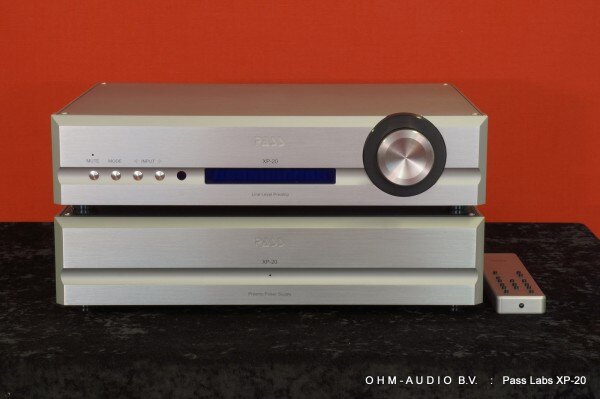
The separate preamplifier takes hold of the incoming signal from the source, attenuates it, and controls the output voltage (Volume) and possibly balance, and sends it to its own output stage. A very good preamplifier has an output stage of much higher and heavier quality than that of a CD Player or DA Converter with adjustable output. The output amplifier of a preamplifier can often deliver 20 Volt without any problem. So the output stage that now drives the power amplifier is of better, more stable and heavier quality than the output amplifier of a CD player or DAC. Advantage 2.
The separate preamplifier has its own chassis, power supply and control circuit. So it's not an output amplifier powered by the same power supply as the DA Converter or CD player. This provides more stability and higher sound quality. Advantage 3.
Controlling the output level (Volume) is a very delicate matter. A simple potentiometer in the signal path doesn't do much good, but a standard digital volume control isn't much better. No matter how you look at it, if you control volume digitally (read: attenuate) then the signal becomes rougher. Bits are lost. It can't be otherwise. The resolution of the music signal decreases. And that's audible. A good external preamplifier has state-of-the-art analog volume control, and that's noticeable. Excellent analog volume control can be achieved with a very high-quality potentiometer, or a circuit board full of relays, and there are also ICs with high-quality analog volume control. Advantage 4.
An external preamplifier has extra options. Extra analog inputs, sometimes a phono preamplifier, dual output stages and so on. More versatile, then. Advantage 5.
In short, a good Hifi or High End installation improves in sound quality and becomes more versatile through the use of a good preamplifier. You don't have to believe us, of course. Best to try it yourself.
Contact Ohm-Audio BV for advice.