Current selection of power amplifiers from Ohm-Audio bv
The power amplifier, also called a power amp, has only 1 task. But it's a very important one. The task is to amplify the audio signal supplied by the preamplifier. That signal needs to be amplified and buffered so that the power amplifier can drive the speakers. The preamplifier delivers a maximum of a couple of volts and only a small amount of current. The power amplifier can deliver many tens of volts and much more current to properly drive the speakers.
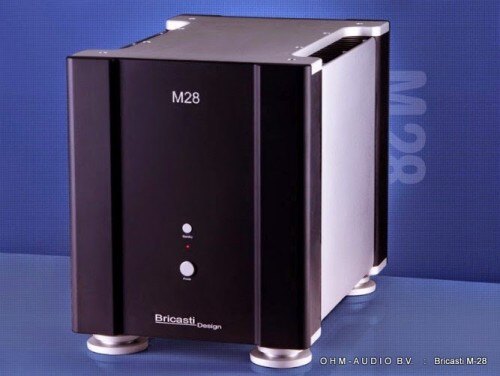
Bricasti M-28 Mono power amplifier
Watt's up?
The big question always was: How many watts does it have? The more watts, the better, people thought. Practice is quite different though. You undoubtedly need some watts to drive your speakers, but exactly how many watts you need to optimally drive your speakers depends on, among other things:
The efficiency of your speakers
The complexity of your speakers
Your music taste
The size of your room
How loud you play your music
......?
Speaker efficiency is always measured in decibels per 2.83 volts at 1 meter distance. That is, dB/2.83V/1m. That 2.83V is actually the equivalent of 1 Watt at an 8 ohm speaker.
Why volts instead of watts? That's because volts indicate the amount of voltage needed to make the speaker move. How many watts that is depends on the resistance of the connected speaker, and that varies for each speaker and each reproduced frequency, so you can't measure with that.
The efficiency of the speaker is usually mentioned in the specifications. For example, it might say: Efficiency: 88dB. Or 85dB. Or 91dB. The higher the number, the higher the efficiency. If you provide a speaker with 88dB with 1 watt of power, it produces 88dB acoustic output, or sound, at 1 meter distance. A speaker with 91dB produces 91dB of sound at 1 watt. More sound with the same power. So the 91dB speaker is more efficient. The more efficient the speaker, the less power your amplifier needs to produce a certain amount of sound.
2. Decibels and power
For every 3dB of additional sound, you need to double the power. In the beginning it doesn't go that fast, but at a given point it adds up nicely. See for yourself.
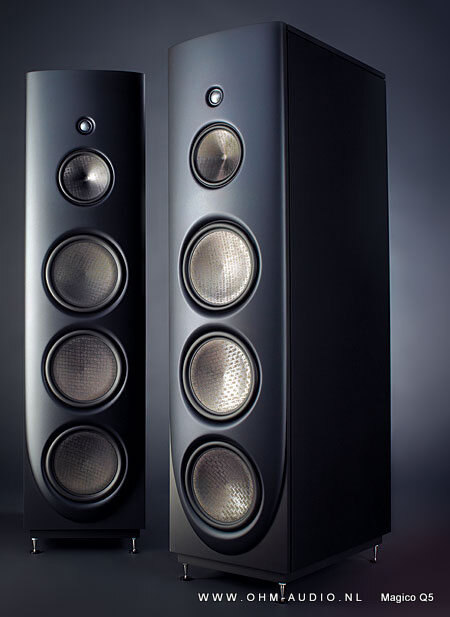
We take as an example a speaker (Magico Q5) with a low 86dB efficiency.
To get 86dB of sound, we have to feed it 1 watt.
To get 89dB of sound, we have to feed it 2 watts. And so on.
Magico Q5
89dB sound, 2 watts
92dB sound, 4 watts
95dB sound, 8 watts
98dB sound, 16 watts
101dB sound, 32 watts
104dB sound, 64 watts
107dB sound, 128 watts
and now it goes fast......
110dB sound, 256 watts
113dB sound, 512 watts
And so on.
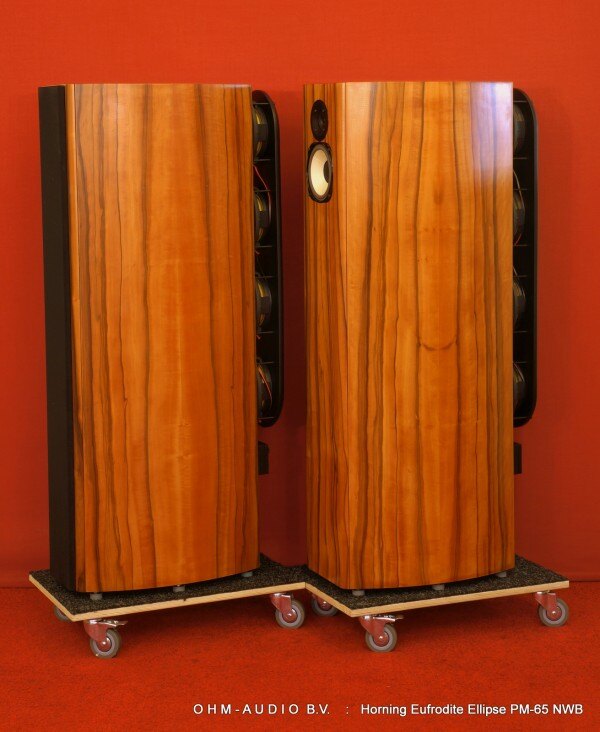
Now if we take a dynamic speaker with a particularly favorable (high) efficiency, the Horning Eufrodite PM-65 NWB with an efficiency of 99dB, things look very different.
Horning Eufrodite PM-65 NWB
99dB sound, 1 watt
102dB sound, 2 watts
105dB sound, 4 watts
108dB sound, 8 watts
111dB sound, 16 watts
114dB sound, 32 watts
117dB sound, 64 watts
And so on.
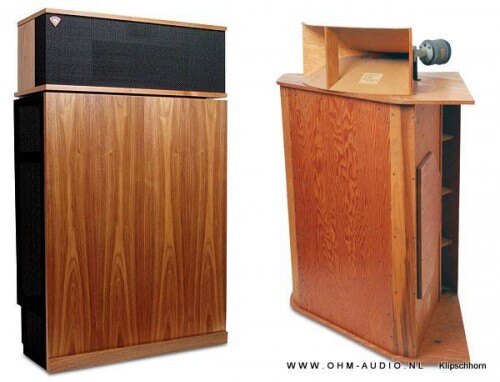
Now if we take a horn speaker (Klipschhorn) with a very high efficiency of 104dB, things look different again.
104dB sound, 1 watt
107dB sound, 2 watts
110dB sound, 4 watts
113dB sound, 8 watts
So to achieve 113dB, which is quite loud, music in the room, we need the following power:
Magico Q5: 2 x 512 Watt continuous amplifier
Horning Eufrodite PM-65 NWB: 2 x 28 Watt continuous amplifier
Klipschhorn: 2 x 8 Watt continuous amplifier
That makes quite a difference. Note well. A high power rating says nothing about the quality of the reproduced music. It only says something about the efficiency of the speaker and the amount of power you need to drive it to get a certain amount of sound, and thus music, in your room.
3. Resistance and impedance
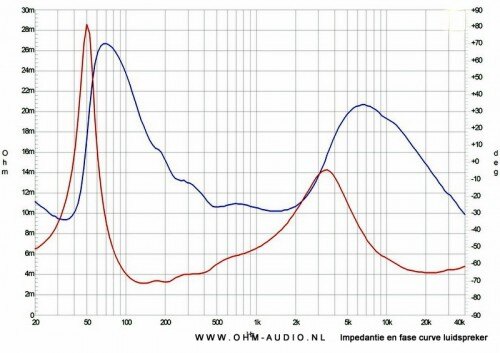
But with just the speaker efficiency we're not there yet. There's another factor at play, and that's the resistance of the speaker. This is measured in Ohms. Often you'll see 8 Ohm or 4 Ohm printed on the back of your speaker. But it's not that simple. The resistance of a speaker changes when you play music, and it actually depends on the frequency. So it can happen that a speaker has a resistance of 60 Ohms at 50Hz, 5 Ohms at 800Hz, 35Ohms at 4000Hz and 2 Ohms at 18000Hz. This is often excellently represented in the red line of the graph.
You see a resistance of 7 ohms at 20Hz, 27 ohms at 50Hz, 3 ohms at 150-225Hz, 14 ohms at 3,500Hz and 4 ohms at 20,000Hz.
Now it is so that you need a certain amount of voltage to make the speaker sound equally loud at all frequencies. And, converted to the amount of watts, it works like this.
The impedance of the speakers thus stands for the resistance of the speaker. The higher the resistance of the speakers, the easier it becomes for the connected amplifier to achieve a certain sound level. That sounds strange, but it's true. You can compare it to a water pump with a water hose with a diameter of 1cm that sprays water. The pump represents the amplifier and the water hose represents the speaker. So there is a water pump that delivers a certain amount of pressure. Suppose the water hose now sprays 4 meters far. That 4 meters represents the sound level of a speaker. If we could now press a button and make the water hose 2 x thicker, so 2cm in diameter, what happens to the water jet? Right, it doesn't spray further than 2 meters. In speaker terms, the sound level becomes 2 x weaker. To get the jet to spray the same distance, the pump now has to deliver 2 times as much water. In other words, the amplifier has to deliver 2 times as much current to the speaker.
Ideally, an amplifier doubles the power when the speaker impedance is halved.
So 2 x 100 watts at 8 ohms delivers a certain maximum sound level. If the speaker impedance drops to 4 ohms at a certain frequency, the amplifier will need to deliver 2 x 200 watts for the same sound level. If the impedance drops to 2 ohms, the amplifier will need to deliver 2 x 400 watts for the same sound level. And so on. The lower the impedance of the connected speaker, the more current the amplifier will have to supply.
There aren't many amplifiers on the market that double their output power down to 1 ohm, but the good news is, that's not always necessary. The fact is, there aren't that many speakers that have a resistance (impedance) of 1Ohm at certain frequencies. But if you have a speaker with a minimum impedance of, for example, 2.5 Ohms at 400Hz, then it is undesirable to use an amplifier that doesn't deliver power or delivers little power at 2.5 Ohms. Most tube amplifiers can't do that. So if you connect such an unfavorable speaker to a tube amplifier, it may sound quite good at some points, and when reproducing voices in the midrange, it can completely collapse and start distorting.
So choose the right amplifier for the speakers you have. Ohm-Audio BV can help and advise you with that.
The right power amplifier for your speakers must therefore be technically suitable for your speakers, but that's not all. The sound character must also match the speaker. That's something personal, but we can often give you advice on it.
Ohm-Audio bv 2018-10