The source is the most important element in Hi-Fi and High End music installation. What the source does wrong will never be corrected later. The source we're talking about is not the CD player or turntable, but the power supply. The Dutch power grid delivers electricity from any random outlet, but unfortunately not every outlet in your house is equally suitable for audio equipment. If you could trace the path of the power cables in your house, you would see that most outlets are connected with a single 2.5mm cable, which often arrives at the outlet via various clamps and distribution boxes where you want to connect your Hi-Fi set. Far from ideal, contamination, power loss and instability are clearly present. And that is clearly audible.
Alternating Voltage: Current and Volt
In Europe, the energy company supplies you with 230 Volts. As it should be. If we now look at our outlet, we see 2 holes and, as it should be, an earth strip. If we insert a voltage tester into one hole, the light comes on, and nothing happens in the other hole. There is voltage on only 1 pole. That voltage is alternating voltage, and looks like a sine wave of 50Hz. The voltage alternates 50 times per second from +230Volt to -230 Volt. AC then, and AC stands for Alternating Current. If we now plug a device into the outlet, current flows from one pin, through the device, to the other pin. Alternately +230V and -230V. The device receives power and can do its job. Only the device receives alternating voltage, but almost all devices operate on direct voltage. DC then, which stands for Direct Current. DC also comes from a car battery or a battery. By the way, it's the case that we don't always get 230 Volt AC from the Energy Supplier. Sometimes it's only 220 Volt AC and sometimes 235 Volt AC or more. That can also explain why it sometimes sounds good one evening and less good the next evening. It's not purely in the voltage, but in the purity and stability of the power supply. But something can be done about that.

Internally, all audio devices operate on direct voltage, DC. Direct voltage is the voltage as it comes from a battery or accumulator. Here too you have 2 poles, but one is zero and the other for example 12 Volt. But now always 12 Volt. Continuously 12V and this does not alternate from +V to -V dozens of times per second. Since audio devices work internally on direct voltage, the alternating voltage from the power grid must be converted to direct voltage, and often 12Volt and 50Volt DC are needed instead of 230 Volt AC. That happens in the device through the complete power supply: Transformers, diode bridges and other rectifiers and Elco's are required. Sounds complicated, but it's not too bad. Each device has 1 or more power supplies / converters.
Now you can imagine that there is quite a bit of residual current from that alternating voltage left after the power supply. That disrupts the proper operation of the device. That residual voltage, visible in the alternating voltage, we call the ripple. Just like the ripple in the pond when you throw a stone in it. Now, the less ripple, the better. The smoother the pond, the better. But ripple not only arises from the residue of that alternating voltage, it also arises from contamination on the power grid. Microwaves, halogen lamps, dimmers, refrigerators and so on contaminate your power grid, and thus disrupt the quality of your audio installation. Even WiFi transmitters, 3G, 4G transmitters, all signals settle in the power cords. Something can be done about this too.
Setup
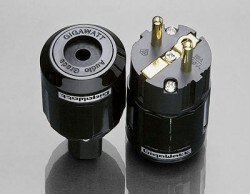
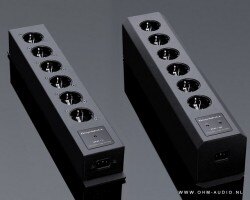
If possible, have a separate power circuit installed for your audio equipment. You achieve the best results with special fuses suitable for audio. The best ones come from Gigawatt Power Products. Gigawatt makes a special single and double 16 Ampere Audiograde switch for your fuse box. That is the Gigawatt G-C16A and the Gigawatt G-C16A Dual. Do not connect fuses, or switches with built-in fuses. Fuses are a brake on the speed of the power supply. Have your installer mount the Gigawatt G-C16A Circuitbreaker in your meter cabinet on the standard rails. For each cable going to your set you need a separate switch. 3 Separate cables means 3 Gigawatt switches. Preferably use the Gigawatt LC-Y Evo installation cable. This cable is an Audiograde installation cable with 3 x 4mm solid OFC copper and is completely shielded. If you use a Gigawatt Powerstrip or Powerconditioner, you only need one cable to your set. Ideally, your installer taps the Phase as directly as possible from the incoming Phase cable, preferably also (audiably) before the residual current breaker. If you want to protect your hifi set power supply against children who might accidentally stick a paperclip or similar in the outlet, always connect after the residual current breaker. Only the Phase (Brown) is connected to the Gigawatt G-C16A Circuitbreaker and with the G-C16A Dual both the phase and neutral are connected. In the Netherlands and Belgium, the Gigawatt G-C16A Twin is required and the single-pole version is not permitted. For the residual current breaker, we recommend Doepke switches. These only minimally affect the current.
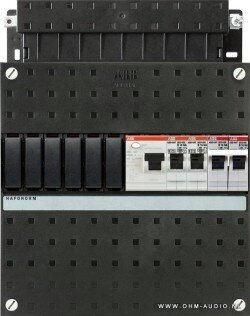
The meter cabinet switch is placed in the meter cabinet. The connection is a standard rail connection, which is used in all modern meter cabinets. Find a suitable place for the Gigawatt switch. Usually there is space in the meter cabinet for a few new switches. If there is no space, we can optionally provide an extra mini meter cabinet for 1 or 2 switches. But let's assume you have space in your meter cabinet. First switch off the main switch. Place the Gigawatt switch on the rails. Connect the phase wire (brown) and neutral wire (blue) to the Gigawatt switch. The input can be placed at either the top or bottom of the Gigawatt switch. It's best to use a piece of LC-Y Evo cable. Simply pull the wires out of the LC-Y Evo cable and insert them into the Gigawatt switch.
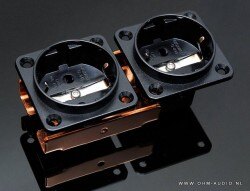
Connect these supply wires to the neutral and phase of the meter cabinet. Now connect the outgoing cable on the other side, which goes to your Hi-Fi installation. This cable, preferably the Gigawatt LC-Y Evo cable, is grounded, which means that in addition to the Brown and Blue wire, there is a third wire, and that is the Yellow earth wire. This earth wire is intended to ground the entire set. The Gigawatt LC-Y Evo cable is also completely shielded with aluminum foil. This foil is 100% sealed and does not allow signals through to the cable. This foil is also connected to Earth in the meter cabinet. But foil is of course brittle and cannot be easily connected anywhere, so a tinned bare wire is included in the LC-Y Evo cable. This earth wire (yellow) with the tinned wire are both connected in the meter cabinet. On the installation side, the outlet, the tinned wire is not connected. You can cut it off. In the meter cabinet, the earth wire, together with the tinned wire, goes directly to the earth pin. Earth has nothing to do with the Gigawatt switch and is therefore not connected to it.
Often the same earth is used for the entire house. Often the outside of the equipment is connected to the earth. Unfortunately not only the casing of your amplifier, but also the casing of your microwave is connected to the same earth. That's why it's even better if a separate earth pin is driven, which will then be connected only to the Audio circuit.
The perfect power solution is an enormous upgrade for your high end audio and video installation, and at, proportionally, very low cost.
In our opinion the most effective upgrade for your installation!
You now have your perfect power cable(s) running to your Hi-Fi installation. Now it's time to look at the perfect power conditioners from Gigawatt Power Products.
The power is now delivered to your Hi-Fi or High End set as efficiently as possible and with as little loss as possible, but distortion in the power is still present.
Ohm-Audio bv is the official importer/distributor of Gigawatt Power accessories and supplies these very high-quality products at attractive prices. All these products stabilize the power supply, buffer power and filter out annoying spikes and distortion from the power, giving you much more musical enjoyment.
More about this you can find on the special page of Gigawatt Power Products and on the page about Power Accessories
Ohm-Audio bv
2025-10