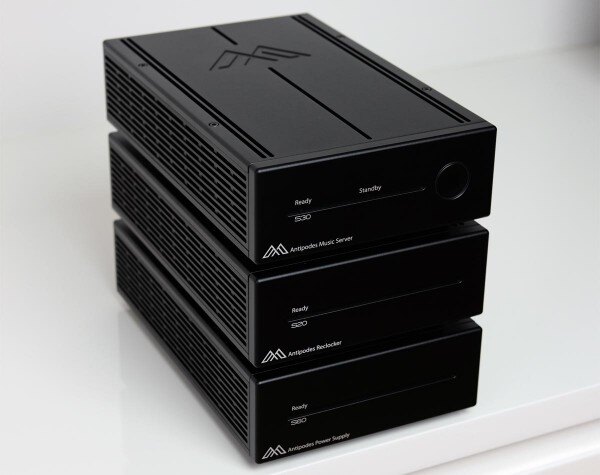
Current range of Ohm-Audio bv streamers
Streaming audio is understood to mean: the playback of music files from a storage system in a "computer-like" audio device. The music is stored in the form of ones and zeros (bits) on a storage system, such as a hard disk drive (HDD), or better yet, a Solid State Drive (SSD). There is therefore no question of a physical digital sound carrier such as a CD, SACD, DVD Audio, DAT tape and the like. Nothing needs to be retrieved from a carrier anymore, the music is already stored somewhere on the streamer. The musical data can thus be stored in the streamer itself, but also on a so-called NAS. That is a Network Attached Storage system, a large storage system with multiple HDDs which can securely store all your data. This NAS is for example in your meter cupboard. Your streamer can retrieve the music from the NAS to play it. But the streamer can also contact external streaming services such as Tidal, Qobuz, Spotify, and retrieve the musical data from there.
You are of course used to playing CDs, at least, if you want to hear digitally stored music. Now that you look at the streamer market, there are quite a few brands and options, and the chances are quite good that you can no longer see the forest for the trees. Ohm-Audio bv can help you with that, at least if you are interested in the highest possible level. Ohm-Audio bv only stocks the best streamers the market has to offer.
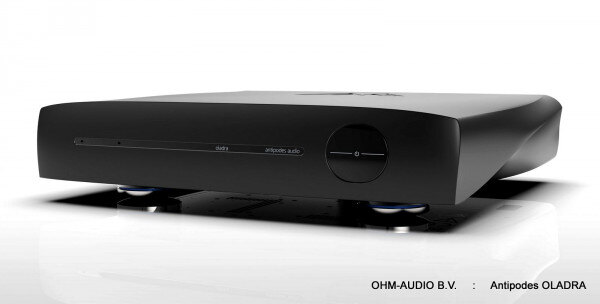
The best sounding way to hear your music is this: You copy the music files to the internal storage of an excellent pure Audio Streamer, and you place this streamer directly at your High End installation. This streamer must then be provided with a good power cord and then connected directly to your Hifi or High End music installation via a USB, AES/EBU or similar cable. In this way, the streamer has full control over the digital files. From input to output. Ohm-Audio bv is the importer of Antipodes streamers from New Zealand. Antipodes Audio makes fantastically built and highly sophisticated and easy-to-use streamers, and according to us they are the best sounding digital streamers at the moment. The entry-level streamer Antipodes S30 costs €3.495,- and the top model, the Antipodes Audio OLADRA K50 costs €24.495,-.
Each system has its own characteristics and therefore also advantages and disadvantages. We will list them in turn.
This category includes the High End music servers from Antipodes Audio from New Zealand. The streamers from Antipodes manage your entire music collection. From a sound quality perspective, this solution is absolutely the best solution. The manufacturer has all the means to optimally prepare the music for output to the DA Converter. A DA Converter is not built into these streamers, and that is a great advantage. You can now choose for yourself what sound quality you ultimately want to achieve. Moreover, DA Converters are subject to obsolescence, new techniques come quickly, and the Antipodes streamer simply grows along with it. Connect the DA Converter via USB, AES/EBU, Spdif, Toslink, I2S etc., and you achieve the highest possible sound quality. We prefer the USB connection because it currently sounds the best, and all file formats such as PCM and DSD pass unhindered to the DA Converter.
Yet there are also many customers who use AES3 or for example the I2S connection. That sometimes sounds a bit less clean and pure, but some find it sounds more musical. Also the Server process, which scans and updates your music collection, and the control app for the player are universal and customized for these streamers. You don't need any knowledge of networks. Connect, install the control app, rip CDs, or turn on Qobuz/Tidal, and play. There are various software systems on each Antipodes Streamer, but we have a clear preference for ROON because of its excellent management capabilities. You buy the music online, or you rip your CDs fully automatically with the Antipodes streamers, and optionally enjoy external music services such as Tidal and Qobuz. A whole new world of music is open to you. Tidal now even streams MQA files, so you get high resolution music through Tidal. Roon server, which runs on the Antipodes streamers, unpacks it and sends it on. Qobuz even sends uncompressed files directly to you. Once your music collection is stored in the internal storage, it is necessary to run a Back Up from time to time. You never know. This is very easy with Antipodes. Connect USB drive, and press make backup, and done.
The highest possible achievable sound quality Optimized for both USB and AES/EBU and SPDIF and possibly I2S High End Audio unit at your installation
Trouble-free operation User-friendly Extremely fast and extremely quiet (no fans) No network knowledge required No servers in the meter cupboard Low obsolescence Low energy consumption Latest software solutions possible such as Roon
Disadvantages:
Storage limited to maximum 24Tb SSD (18,000 DSD or 48,000 uncompressed CDs) Occasionally backup stored music via USB disk or Network to NAS.
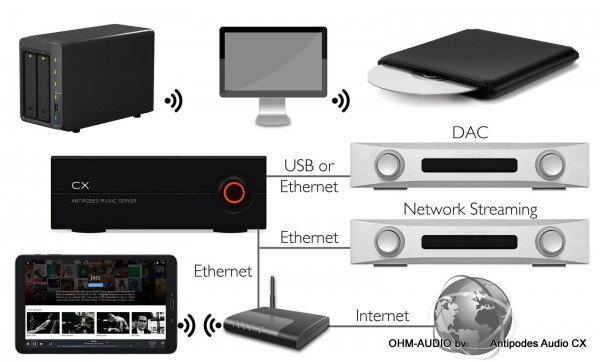
Antipodes CX connection diagram
This category includes streamers from Linn and Lumin for example. Once connected to your High End installation, these servers do not yet produce music. For that you must install a NAS (Network Attached Storage) in your meter cupboard, with the server software recommended by the streamer manufacturer, such as Squeezeboxserver or Minimserver. Once this software has been successfully installed, you must copy your music to the NAS. After that, the streamer sees the server remotely, and it can then retrieve the music from the server to play it. Of course, the streamer is then dependent on the quality of the server and the connection, and that is where the disadvantage of this construction lies. The output of the bits can never be controlled as well as with the servers with internal storage. The advantage is that these NAS systems often contain multiple drives that are often in RAID 5, so you don't really need to run backups. The streamers without built-in storage usually have a DA Converter on board. Sometimes a reasonable one, and sometimes an extremely good one. However, these systems become obsolete a bit faster. When a new DA Converter technology comes to the market, you cannot upgrade. In terms of operation, these systems can work just as well as the systems with built-in storage, although the systems without built-in storage are often slower.
Unlimited storage capacity (Although 24Tb SSD in a K50 or K40 is hardly a limitation anymore) Extremely quiet. Noisy NAS in the meter cupboard Built-in DAC can handle the many file formats offered Backup is on the NAS itself
The Streamers become obsolete sooner No choice in DA Converters Control app not always stable
Not the absolute highest digital quality possible
Knowledge required of NAS Systems NAS Systems become obsolete and wear out and have high power consumption System is completely dependent on your network Often slow Very good UTP connection cables required No stable and fast ROON server function possible USB or AES3/SPDIF?
Some streamers seem to focus on the USB output, while there are also brands that offer only a non-USB output, so AES/EBU and the like (SPDIF, Toslink). Why is this? The USB output on high-quality streamers is of an extremely high level. All types of file formats can be played by the USB output. The USB output leaves the signal untouched. PCM remains PCM and DSD remains DSD. It is the DA Converter that determines the conversion, and thus also partly the final playback quality. However, there is something to be said for USB.
USB
First, the USB input module/circuit board is powered from the streamer. This means that the output quality of the USB output of the streamer is therefore of great importance, because a power signal also runs through the USB cable. Also be careful when changing USB cables while the unit is on. It is better to turn off the streamer, power off, before you disconnect the USB cable.
Second, there is no clock signal running through the USB cable. It is therefore the DA Converter that generates the clock signal for the conversion of digital to analog. Expensive DA Converters such as the Bricasti M1 have an extremely good and accurate clock built in to perform the conversion as precisely as possible. An AES/EBU and SPDIF cable do that completely differently.
AES/EBU and SPDIF
There is also something to be said for an AES/EBU or SPDIF connection. An AES/EBU or SPDIF cable is intended solely to transport PCM signals, and then up to a maximum of 32bit/384khz. DSD simply does not go through the cable, except very occasionally as DOP. The sender and receiver of AES/EBU and SPDIF are not designed for this. If you play DSD files via an AES/EBU or SPDIF cable, this signal will have to be converted to PCM. This comes at the cost of quality, because every form of conversion results in loss. Is that a big deal? Not necessarily, a matter of listening and taste.
With regard to the clock. Unlike USB, the AES/EBU and SPDIF cable do transport a clock signal. If you use an AES/EBU or SPDIF cable, the clock in the streamer is therefore decisive and not the clock in the DA Converter. That can be an advantage, if the clock of the streamer is very good, or disadvantageous, if the clock in the DA Converter is better than the clock in the streamer.
We at Ohm-Audio bv do not really have a preference and according to us there is no real winner to be found either. The top model of Antipodes Audio, the K50, has both an excellent USB output, as well as an excellent AES/EBU and SPDIF and even an i2s output, with an excellent Femto clock. This clock is extremely precise and the signal from these outputs is therefore the highest achievable. The Antipodes Audio K30 streamer is built around the USB output and has no AES/EBU and SPDIF outputs. A Grimm Mu1 is in turn a streamer that exclusively has AES/EBU outputs, because we believe that an AES/EBU output is better than a USB output. We think you can best make that choice yourself. We have carefully listened to both outputs, at different streamer brands, and have heard excellent results from both types of connections.
For the ultimate music experience, Ohm-Audio BV recommends the solution with a Streamer with integrated storage, and an associated DA Converter of the highest possible quality, for the very best music experience. In addition to Antipodes Audio, Ohm-Audio BV also supplies streamers from Lumin.
Ohm-Audio bv 2021–04