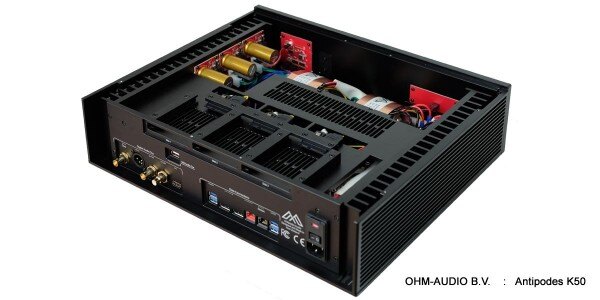
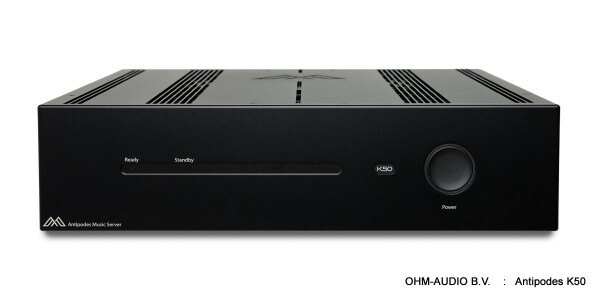
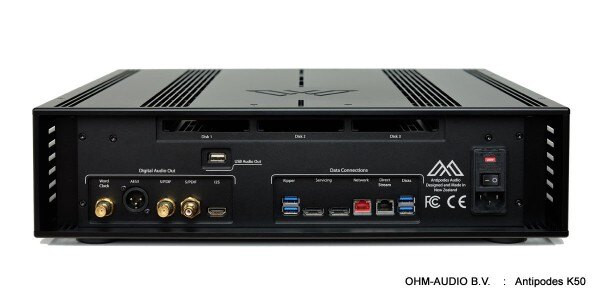
Antipodes Audio New Zealand makes the best sounding and functioning music streamers in the world. The current Antipodes CX and EX are of absolute world class and combined are in a class of their own, but according to Antipodes Audio it can be even better. For this, new software has been written, new housings have been made, and a new semi switched mode / linear power supplies have been developed. The new flagship model, the Antipodes K50 even has 3 power supplies, 2 mainboards and an advanced reclocking system built in, and is ready for 24Tb of SSD storage! The absolute new reference in the field of streaming audio.
The development towards the new models emerged from an extensive research project, where all possible improvement possibilities for music streamers were examined. This project is the OLADRA project of Antipodes Audio. Some technical matters are outlined below.
Project OLADRA began more than 3 years ago, looking at the reasons why many music servers fell short compared to the very best turntables in terms of dynamics and emotional engagement. Early on it was thought that successfully managing noise interference was sufficient to increase quality, and so Antipodes Audio focused their attention on increasing bandwidth (speed). The project influenced the designs of the CX and EX more than three years ago. But there was much more to come. Three years later, the project has delivered the new K-series and S-series which provide improvements in transparency, resolution, naturalness, dynamics and especially musical expression. This article describes the importance of the two-fold goals of reduced noise and greater bandwidth. From a sound quality perspective, the goal of a music server is very simple, namely to perfectly transmit a square wave representation (digital) of the music file to the DAC. Unfortunately, the difficulty is in achieving exactly this perfection. This goal is underestimated by many manufacturers and in practice it can unfortunately never be completely perfect. The concept of Jitter (timing errors in the digital data stream) makes people think that all you need for a perfect digital signal are pure bits, with great timing (low jitter), and therefore all you really need is a fantastic clock. This simplistic view is simply incorrect. This article does not tell the whole story, but instead tries to make the problems understandable. There are at least three things of importance in our audiophile streamer world:
1. The clock
2. Noise
3. Bandwidth
Simply put, the difference between a great clock and an ordinary clock can be completely eliminated if there is sufficient noise and / or the bandwidth is sufficiently limited. And this is almost always the case, and then an expensive clock makes no sense at all. This article describes as simply as possible how noise and bandwidth limitations cause jitter, regardless of the clock used.
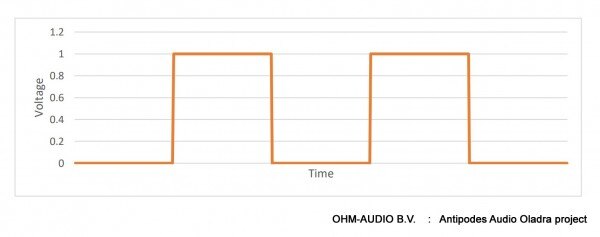
In the image of a perfect square wave below, the horizontal axis is Time, and the vertical axis is Voltage. We assume that the clock is perfect, meaning that the vertical signal lines are at the perfect mutual distance with exactly the same intervals (the bit rate). If the signal represents a binary 0, it is at 0v. If the signal represents a binary 1, that is 1v. We also assume that the receiver of this signal decides what the transition between a 0 and a 1 is. Namely, when the signal is above 0.5 volts, it is a 1, and when the signal is below 0.5 volts, it is a 0. The image below shows exactly the unattainable goal of all music server manufacturers.
PHOTO 1Now imagine that noise is added to the signal. And that is always the case to a greater or lesser extent. If the frequency of the sound is lower than the bit rate itself, then you will see it back on top of the perfect square wave, which is now distorted at the top.
The interesting thing to note is that the timing between the data transitions is unchanged. A 0 is still a 0 at the same moment, and a 1 is still a 1 at the same moment. So this should be no problem at all, you would say. If the frequency of the noise is not below, but above the bit rate, the horizontal lines become blurred.
And if we combine the low-frequency noise with the high-frequency noise, the effect is combined.
The signal is heavily distorted and wobbly, but the interesting point to note here is that the timing between the data transitions (where vertical lines run through 0.5v) is unchanged, provided the noise is not extremely high of course. So again, there appears to be no problem at all. Noise, in itself (as long as it is lower than 0.5v) apparently is no problem, and the reason it is no problem is our assumption that the vertical lines are indeed 100% vertical.
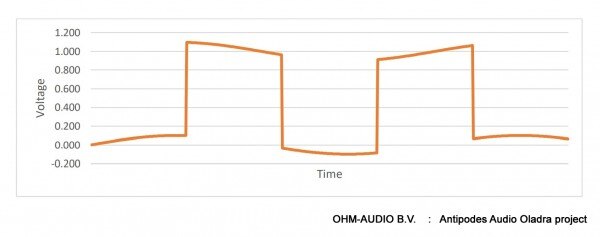
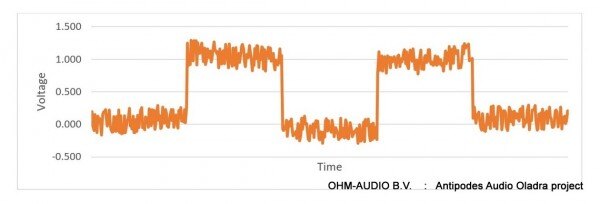
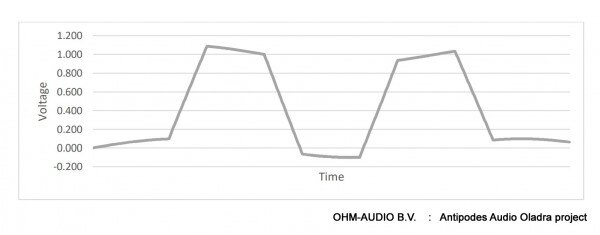
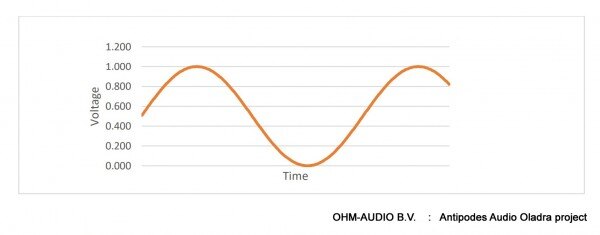
Now imagine that there is no noise at all. No noise may be impossible, but what is definitely impossible is a perfect vertical line, because it can only exist if the speed and bandwidth of the circuit is infinitely high, and that does not exist. To illustrate this, see the next photo with a perfect sine wave. The vertical lines indicate the signal strength between 0 volts and 1 volt.
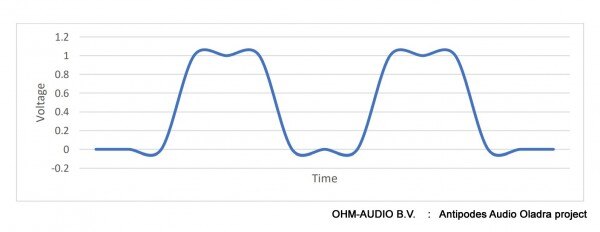
To extract this signal, you need to add different harmonics of the bit rate (preferably 7 or more) above the bit rate, and that is a lot of bandwidth. The bit rate is already very high for CD-level resolution and high-resolution signals require even much higher bandwidth. The following image shows how a sine wave begins to square when you add a harmonic to it.
Interestingly, in both of these examples of limited bandwidth, the transitions at 0.5 volts are still perfectly spaced apart, even with the sine wave. So we still haven't found a problem. As mentioned, a signal with a higher bit rate requires even much more bandwidth to extract the sine from it, and therefore in a system that does not have an infinite limit on bandwidth, a signal with a lower bit rate is represented more accurately than a signal with a higher bit rate. So a High Resolution file causes more problems than a CD resolution signal. This should give food for thought for audiophiles. If you ask something in a computer to work faster, it works with less precision. This is an important point before assuming that higher bit rates must be better because they have higher resolution.
So why are noise and bandwidth important? The attentive reader will realize that with the above examples we only conclude that there is no problem if we have no noise in the system, and a system with infinite bandwidth. But each of these goals is unattainable and the problem becomes quite clear when there is both noise in the system and limited bandwidth. In the image below, a low-frequency noise component has been added to a digital audio signal with finite bandwidth.
As you can now see, the 0.5v points have been shifted to the right or left by the addition of the low-frequency noise that raises or lowers the signal between bits 0 and 1. If you shift the slopes up or down, the 0.5v points shift left or right. The music waves now change, and your streamer will sound different, in other words, distortion.
Jitter
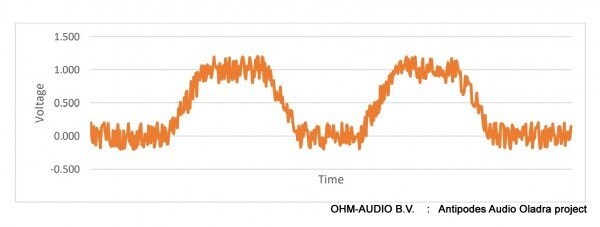
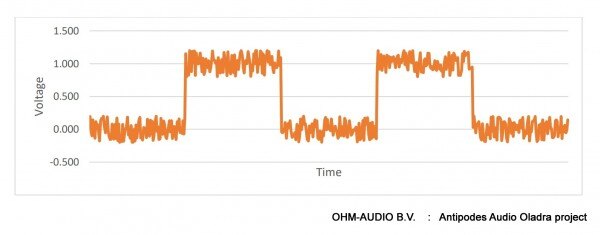
The greater the amplitude of the noise and the greater the bandwidth limitation, the greater the effect on timing (jitter). In the image below I have added high-frequency noise to a frequency-limited signal.
As you can see here, the transition time at exactly 0.5V is now difficult to distinguish for any digital receiver. If the signal is vertical at the transition, noise has no effect on it. But as soon as the transition is not vertical, then noise changes the transition point. And this is the whole point. Combining limited bandwidth and noise inevitably causes jitter, regardless of how good the clock is. What we often see nowadays is that music servers are designed using very simple computer components, in a beautiful housing. These types of products produce a lot of noise, with filters added in later stages to reduce that noise. And we also see music servers that are powered by slow linear power supplies, used in the wrong places. It seems that few manufacturers realize that these noise filters greatly reduce bandwidth, and that this greatly increases jitter, and that this has at best a much less favorable effect than the noise figures suggest. There also seems to be little understanding with very few manufacturers for the need for very fast power supplies at important points in the electronic circuit. The OLADRA project of Antipodes Audio New Zealand has become the starting point for the production of a new generation of music servers. These have been completely redesigned to have both an ultra-low noise level and extremely high bandwidth. Because zero noise and infinite bandwidth are unattainable, the best compromises between noise and bandwidth must be sought in different parts of the circuit. As with other areas in high-end audio, this means many hours of objective listening, and combining this with pure science. By this is meant that listening is an essential aspect in high-end audio, rather than blindly relying on technical aspects alone. The OLADRA project of Antipodes Audio has resulted in a new generation of music streamers which not only sound significantly more transparent, but are also definitely more musically expressive, so that more of what is important in the music comes through to you as a listener. The most important tools used by Antipodes in this project relate to two important technology areas:
ISM - Interference Spectrum Management: Noise interference in computers can be reduced, shifted and spectrally spread. The tools already exist with computer board manufacturers, so motherboard manufacturers can comply with RFI and EMI noise interference rules. But with these tools, much more can be done to eliminate the impact of noise on the digital audio signal. Antipodes has been using these ISM tools since 2011 to build leading servers in terms of sound quality, but the OLADRA project provided yet another massive leap forward for Antipodes' ISM technology.
HSL - Hybrid Switched Linear: Antipodes is now using HSL power supply technology for the first time. These are new super-fast and stable power supplies that have the speed of the fastest switched power supplies, and combine these with the ultra-low noise level of the best linear power supplies. For the OLADRA project, Antipodes developed entirely new power supplies for power supply that make this ideal for the first time. The design is considerably more complicated than that of our earlier power supplies, and that of the competition, but the results are spectacular, with a dramatic improvement in sound quality in digital audio circuits. And that's what it's all about.
Ohm-Audio BV 2020-07